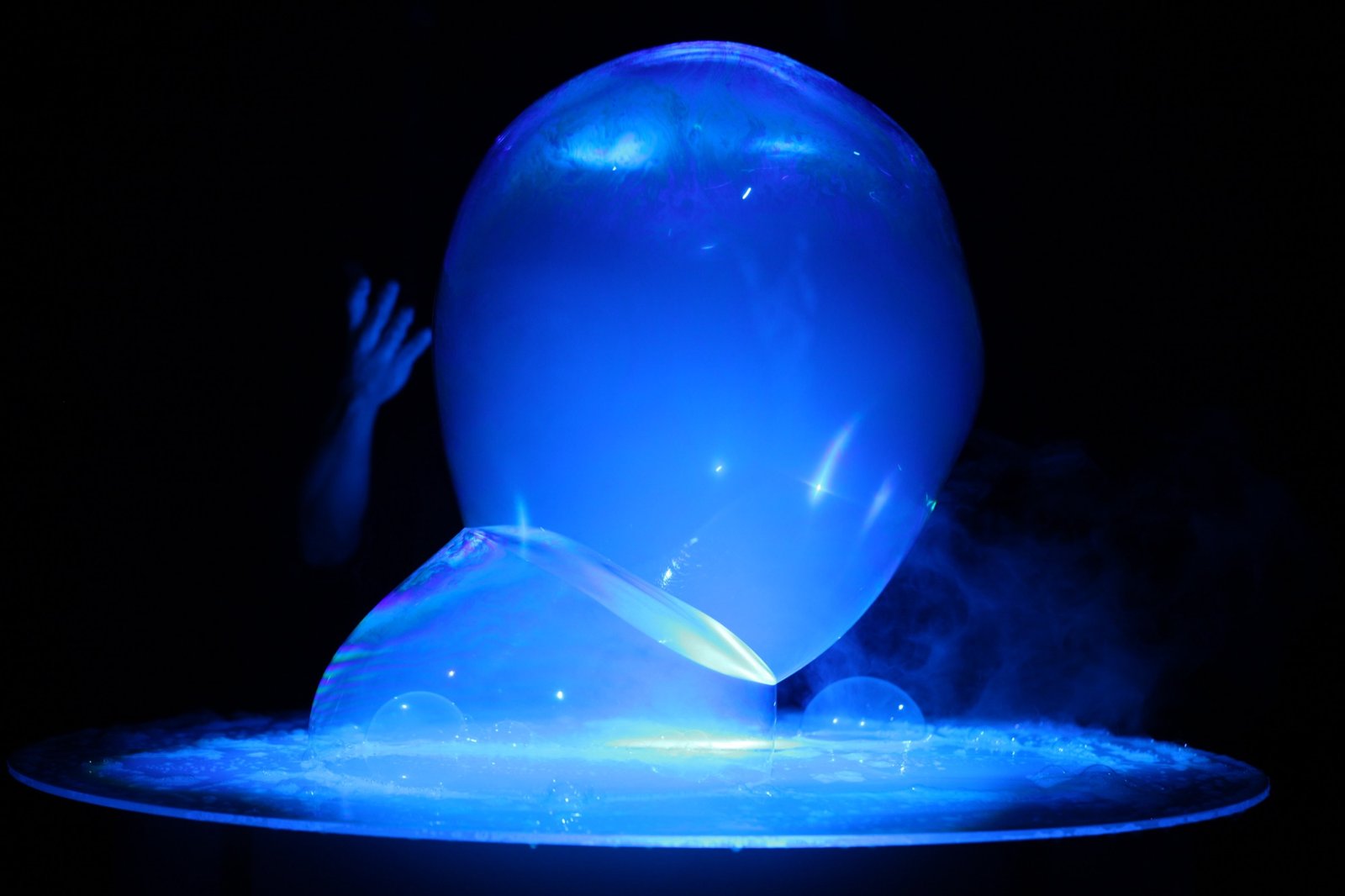
Why do professional bubbles survive for minutes while hobbyist bubbles pop in seconds? The answer is not soap — it is polymer chemistry.
If you have ever watched a professional bubble artist work and wondered why their creations seem to defy physics — floating impossibly long, stretching into shapes that should not hold — the answer is not magic. It is a precise understanding of surface chemistry that most hobbyists never discover because it is rarely written down anywhere accessible.
The standard beginner formula — soap, water, glycerin — produces bubbles that last a few seconds in average conditions. This is because glycerin, despite its reputation as the "magic ingredient," has a relatively limited effect on film strength. It slows evaporation slightly, but it does almost nothing to improve film elasticity, which is the property that determines whether a bubble survives a gust of wind, a change in humidity, or contact with a surface.
Professional bubble artists use polymer additives that fundamentally change the mechanical properties of the soap film. The key players are:
This is the question asked most often in bubble communities, and the answer lies in physics. Glycerin is a humectant — it attracts and retains water molecules, which slows down the evaporation of the thin water layer in the soap film. In dry conditions (below 50% humidity), this can be the difference between a 3-second bubble and a 10-second bubble. But once you cross into higher humidity ranges, or once you need a bubble that physically bends and stretches under stress, glycerin's contribution becomes marginal. What you need is a viscoelastic film — and only polymers create that.
Humidity is not just a background condition — it is an active ingredient. At 85% humidity, even a simple soap-and-water solution produces surprisingly good bubbles, because the atmospheric moisture slows evaporation almost as effectively as glycerin. At 40% humidity, no amateur formula survives more than a few seconds outdoors. Professional formulas are calibrated for the specific humidity of the performance environment, with polymer concentrations adjusted accordingly. This is why a formula that works brilliantly at a beachside venue may underperform at a high-altitude dry-climate show.
After seventeen years of performing worldwide — on cruise ships, in ice shows, at festivals across five continents — Javier Urbina had accumulated a body of empirical knowledge about bubble chemistry that simply did not exist in any accessible form. He had tested hundreds of formula variations against real performance conditions: different climates, different soap brands, different polymer sources, different water qualities. The patterns were clear but complex. Rather than keep that knowledge private, Javier built Kuantika.io: the world's first scientific bubble-formula simulator, where every ingredient is modelled against real physical properties and the output is a predicted performance score across three dimensions — giant size, stability, and structural strength. The science is open. The formulas are yours to experiment with.
Try the Kuantika.io simulator free — design your own formula, compare ingredients, and see the science behind every bubble you make.
Open the simulator →Want to learn the formulas in person and put them into practice with professional tools? Javier's workshops cover everything from basic chemistry to advanced performance technique, with hands-on time building and testing your own solutions.